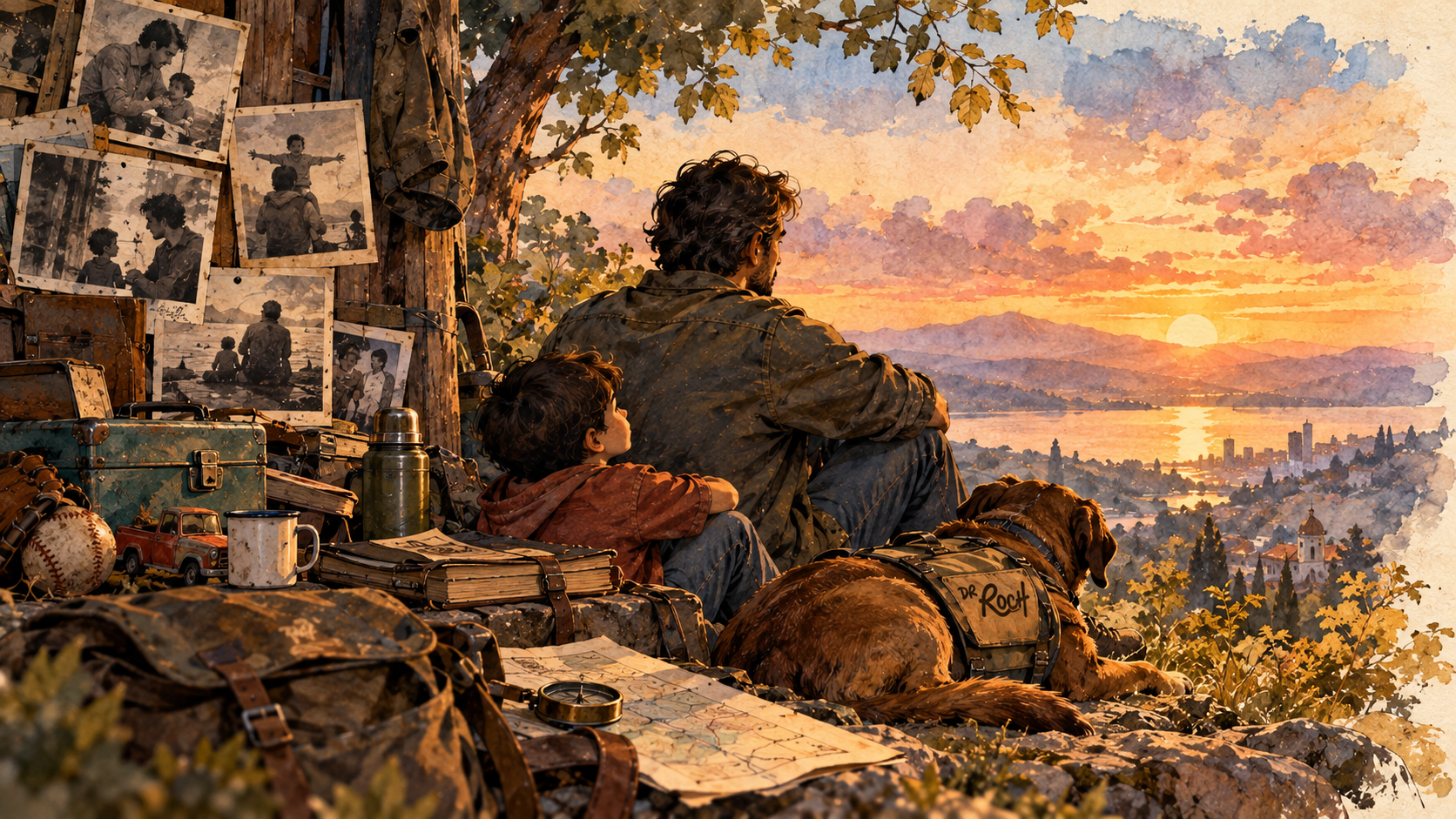
WHEN YOU DISCOVER THAT YOUR FATHER WAS ALSO A MAN
When you discover that your father was also a man
Understand their history without justifying the hurts and stop expecting the past to change
By DrRoch
One of the hardest parts of growing up happens when we stop looking at our father only as "dad" and begin to discover the man who existed behind that name.
A man who had a childhood.
That he had fears.
Who probably also had injuries.
That he made mistakes.
That it had limits.
That she learned to love in the way she was able to learn.
And this can be painful.
Because for many years a part of us may continue to hope that one day our father will finally give us what we feel was missing.
A hug.
One word.
A presence.
An approval.
Apologies.
An acknowledgment.
Or simply the feeling of having been loved enough.
The problem is that we can grow physically while an emotional part continues to wait.
Hoping Dad will change.
That he understands.
That he recognizes.
Let him repair it.
That he finally becomes the father we needed.
And sometimes it happens.
But other times it doesn't.
It can even happen that our father is no longer here, and yet the waiting continues within us.
That's where a different kind of maturity begins.
It does not consist of saying:
«"What he did was right.".
It is not about justifying what hurt us.
It is not about denying abandonment, absence, harshness, silence, or mistakes.
It consists of being able to hold two truths at the same time:
My father could have hurt me.
And also:
My father was a human being limited by his own history.
Understanding does not mean absolving.
Understanding means expanding reality.
Perhaps he too received little.
Perhaps he never learned to express affection.
Perhaps he thought that providing was enough.
Perhaps he confused authority with distance.
Perhaps he repeated what he had seen.
Perhaps he was fighting battles that we, as children, could never know about.
None of that erases what happened.
But it can help us stop turning their story into our destiny.
Because there comes a point when a question changes.
It is no longer just:
«"Why didn't my father give me what I needed?".
But:
WHAT AM I GOING TO DO TODAY WITH WHAT I DID NOT RECEIVE?
That's where the scam comes in.
Not to change the past.
To prevent the past from continuing to dictate all the decisions of the present.
You may never receive that apology.
You may never hear that phrase.
Perhaps your father will never fully understand what you needed.
But there is something you can start doing: stop waiting for the past to change so you can live differently.
You can recognize:
«"You are my father.".
I received life from you.
I also received things that were good for me and others that hurt me.
What belongs to you, belongs to you.
What I am responsible for healing is now my responsibility.
And with the life I received, I decide to move forward.".
That's not forgetting.
It's about stopping waiting.
It is not denying the wound.
It's about ceasing to live inside it.
It's not about ceasing to love your father.
It's about no longer needing them to become someone else in order to be at peace.
The father you needed and the father you had
There is a difference that can be very painful to accept:
The father you needed is not always the same as the father you had.
Perhaps you needed one that was more present.
More affectionate.
More patient.
More available.
More protective.
Even more proud of you.
More able to listen to you.
More willing to say:
«"I love you".
«"I'm proud of you.".
«"Forgive me".
«"Count on me.".
And perhaps it wasn't like that.
For a long time we can build a relationship not only with the real father, but also with the imagined father.
The one who should have been.
The one we hope will appear someday.
The one we see in other families.
The one we needed when we were children.
And the greater the distance between us, the greater our pain can be.
But there comes a time when we need to look at the big picture.
Not to be complacent.
To stop fighting with a reality that has already happened.
Because it's one thing to wish something had been different, and quite another to spend your whole life internally demanding that the past be rewritten.
THE PAST CANNOT GIVE YOU TODAY WHAT IT DID NOT GIVE YOU YESTERDAY.
But you can decide what to do with that absence.
When the child is still waiting
Sometimes we think we've already overcome our relationship with our father.
Until someone criticizes us.
Until a couple recognizes us.
Until our boss values our work.
Until someone walks away.
Until we feel we have to prove our worth.
And then a reaction appears that is much larger than the present event.
Because perhaps we are not only reacting to that person.
Perhaps there's a part of us saying:
«"I'm not enough again.".
«"They don't see me again.".
«"I have to prove myself again.".
«"They've dumped me again.".
«"Once again, someone important is unavailable to me.".
That doesn't mean that every adult problem stems from our parents. That would be too simplistic.
But our early experiences can influence the expectations, fears, and ways of relating that we carry into adult life.
That's why it's worth asking ourselves:
Am I responding to what is happening today, or also to what hurt me yesterday?
That question can change a life.
Stop asking the world to fix Dad
There is another silent phenomenon.
When we don't receive something important, we can spend years trying to get it from other people.
We seek approval.
Recognition.
Attention.
Security.
Protection.
Belonging.
And, without realizing it, we turn our partner, our boss, our friends, our children, or even the public into candidates to fill an old absence.
«"Tell me I'm enough.".
«"Tell me you're proud of me.".
«"Don't abandon me.".
«"Need me.".
«"Recognize me.".
«"Look at me.".
«"Validate me.".
And here's something important: no adult can go back in time and become the parent you needed when you were a child.
He can love you.
He can accompany you.
It can recognize you.
He can build an extraordinary relationship with you.
But she shouldn't have to bear the responsibility of completely repairing a story that began before she met her.
Maturing also means ceasing to demand that the present pay the emotional debts of the past.
Your father was also a son
There is an image that can change our perspective.
Before he was your father, he was a child too.
She also needed love.
He was also afraid.
He also sought approval.
He also lived through experiences that marked him.
Perhaps he had a distant father.
Perhaps he suffered excessive discipline.
Perhaps she learned that crying was a sign of weakness.
Perhaps no one hugged him.
Perhaps he grew up listening to:
«"Men don't cry.".
«"Work and don't complain.".
«"You have to be strong.".
«"Feelings are useless.".
Perhaps she learned that to love meant to provide.
That to protect meant to control.
That educating meant demanding.
Being a father meant not showing vulnerability.
Perhaps he inherited a way of life that he never questioned.
And then the day came when she had children.
No manual.
Without necessarily having resolved their own story.
And he began to give you what he knew how to give.
Sometimes a lot.
Sometimes very little.
Sometimes good.
Sometimes clumsily.
Understanding this does not mean making all harm acceptable.
It means discovering that people can transmit what they never learned to transform.
And then an extraordinary possibility appears:
May history reach you and not have to continue the same after you.
You can be the breaking point
Perhaps your father didn't know how to say "I love you".
You can learn to say it.
Perhaps he didn't know how to listen.
You can listen.
Perhaps he never apologized.
You can do it.
Perhaps he was absent.
You can choose presence.
Perhaps he was in control.
You can learn confidence.
Perhaps he used fear to educate.
You can build boundaries without destroying bonds.
Perhaps he never spoke of emotions.
You can learn a new language.
Then the inheritance changes.
Not because you erase your father, but because you become aware of what you don't want to repeat.
HONORING YOUR HISTORY DOES NOT MEAN REPEATING IT.
Sometimes, the most profound way to honor those who came before is to do better what they could not do.
When your father is no longer there
There is an even more difficult situation.
What happens when our father has already died?
So where do we take all the words we didn't say?
Where do we put our anger?
Gratitude?
The question?
The complaint?
The apology we never received?
The hug that's still pending?
Death may close the possibility of an external conversation, but it does not necessarily close the inner work.
You can still write.
Remember.
Talk.
Name what hurt.
Also mention what you received.
Acknowledge the good without denying the difficult.
Saying goodbye to what never happened.
Because sometimes we don't just need to say goodbye to a person. We also need to say goodbye to the expectation of what we still hoped to receive from them.
And that goodbye can be deeply painful.
Because while you wait, the possibility remains open.
When you accept that it will no longer happen, grief appears.
But after the grief, something may appear that did not exist before:
Freedom.
Forgiveness is not an obligation
I also want to make an important clarification.
You don't need to rush to forgive.
Forgiveness should not be used as a way to deny pain.
Nobody should impose on you:
«"Forgive him already.".
«"He was your father.".
«"He probably did what he could.".
«"Forget the past.".
No.
First we need to acknowledge the truth of our experience.
If it hurt, it hurt.
If there was an absence, there was an absence.
If there was violence, we don't have to romanticize it.
If destructive behaviors existed, understanding their origin does not make them correct.
Perhaps forgiveness will come someday.
Perhaps it will take a different form than you imagined.
But before forgiveness, there may be something equally powerful:
ACCEPTANCE OF REALITY.
«"This happened.".
«"I can't change it.".
«"Yes, it affected me.".
«"But I no longer want it to determine my entire life.".
That may be a sufficient start.
From the wound to responsibility
While we are children, we depend deeply on our parents.
We don't choose where we are born.
We don't choose what they know.
We don't choose what wounds they have.
We don't choose how emotionally available they are.
We don't choose many of the things we receive.
But there comes a time in adult life when a new responsibility appears.
We are not responsible for everything that happened to us.
But gradually we become responsible for what we do with what happened to us.
That difference is fundamental.
Because as long as all the responsibility remains outside of us, our power will also remain outside of us.
«"I am like this because my father...".
«"I can't because he...".
«"I'll never be able to trust because...".
«"Everything I do comes from…".
Your story explains a lot.
But he doesn't have to dictate them all.
The Scam asks:
- What happened?
- What did I learn from that?
- What do I keep repeating?
- What do I no longer need to repeat?
- What can I choose today?
That's where the transformation begins.
Perhaps your father cannot change
This may be one of the hardest truths.
Maybe your father is still alive and will never change.
Perhaps he will remain distant.
He may never admit his mistakes.
Perhaps he still believes he did everything perfectly.
Perhaps I don't have the words you need.
Perhaps he has a completely different version of the story than you do.
And then a crucial question arises:
WILL YOUR PEACE DEPEND ON HIM CHANGING?
Because if the answer is yes, we have still surrendered a huge part of our freedom.
You can talk to him.
You can set limits.
You can come closer.
You can walk away if necessary.
You can ask.
You can express yourself.
You can try to build something different.
But then there is a boundary: you cannot do for another person the inner work that only they can do.
And recognizing that boundary is also a sign of maturity.
Look at him as a man
Perhaps one day you will be able to look at your father and see something different.
Not just the hero you imagined.
Not only the person responsible for your injuries.
But to man.
With lights.
With shadows.
With successes.
With errors.
With talents.
With limitations.
With a history that predates you.
And perhaps at that moment something important will happen: you will no longer need to place it at one of two ends.
«"It was extraordinary.".
EITHER:
«"It was terrible.".
Because human reality almost never fits completely into a single sentence.
Perhaps you could say:
«"My father gave me wonderful things and also left me with wounds.".
«"I can be grateful for some things and regret others.".
«"I can love it and set limits.".
«"I can understand it without justifying it.".
«"I can recognize her story without carrying it.".
That's a grown-up perspective.
And if you are a father today…
Then this reflection takes on another dimension.
Because one day your children will also discover that you weren't just "dad".
That you were a man.
That you were afraid.
That you made mistakes.
There were days when you didn't know what to do.
That sometimes you reacted from your own wounds.
That there were things you did extraordinarily well.
And others that they may have to work on.
There is no such thing as a perfect father.
But a conscious father can exist.
One who learns.
That listens.
That he makes mistakes and admits them.
He asks for forgiveness.
What can you say?
«"I did this wrong.".
«"Tell me how you experienced it.".
«"I want to understand you.".
«"I love you even though I don't always know how to show it.".
Perhaps the greatest gift we can give our children is never to make mistakes.
That's impossible.
Perhaps it's about teaching them that love can also heal.
Before it's too late
If your father is still here and there's a relationship where you can get close without putting yourself at risk, it might be worth remembering something:
Time is not infinite.
Perhaps there's a conversation that needs to be had.
A question.
Thank you.
A hug.
A:
«"I want to get to know you better.".
«"Tell me about your childhood.".
«"What were you afraid of?".
«"What did you dream about when you were young?".
«"What was the most difficult thing about being my father?".
«"Is there anything you've never told me?".
We often know our parents as parents, but we never truly get to know the people they were.
And one day the questions remain…
But they are no longer here to answer them.
Don't necessarily wait for a crisis to occur before asking.
Sometimes loving also means having conversations while there is still time.
The journey continues
Perhaps you can never change the story you lived with your father.
But you can change the place that story occupies within you.
You can wear it like a sentence.
Or as a part of your story.
You can repeat it.
Or learn from her.
You can keep waiting.
Or start walking.
You can live trying to receive what was missing.
Or become someone capable of building it.
Perhaps that, deep down, is what growing up is all about.
Discovering that Dad was also a man.
And that you are no longer just the boy or girl who was waiting in front of him.
Now you're an adult.
You can look back.
You can recognize.
You can cry.
You can say thank you.
You can set limits.
You can say goodbye to some expectations.
You can keep what you did receive.
You can decide what you don't want to repeat.
And, above all:
YOU CAN MOVE ON.
Not because nothing has happened.
But because it happened.
And yet you are here.
With a story.
With wounds, perhaps.
With learning.
Possibilities.
And with something that no past can completely take away from you: the ability to decide what kind of person you want to be from now on.
Your father had his own story.
You have yours.
And there comes a time when loving, healing, and maturing means being able to say:
«"DAD, YOU ARE PART OF MY STORY, BUT YOU NO LONGER NEED TO BE THE AUTHOR OF MY DESTINY.".
Breathe.
Look at reality.
Honor what was.
Acknowledge what was missing.
Keep what was worth it.
And keep walking.
Timo already knows the way.
DrRoch
Related Articles